The Asiatic Society of Mumbai
Mumbai Research Centre
UNSEEN ALIBAUG (A Visit)
19th December 2022 – 7 a.m. to 8 p.m. – Ex-Chembur
Rs.2,200/- (for members Rs.2,000/-)
Payment link for unseen Alibaug (General) : https://rzp.io/l/AliGen
Payment link for unseen Alibaug (Members) : https://rzp.io/l/AliMem
- Prof. Mangala Sirdeshpande, Hon. Secretary
- Dr. Shehernaz Nalwalla, Chairperson, Mumbai Research Centre
 The Asiatic Society of Mumbai, Mumbai Research Centre
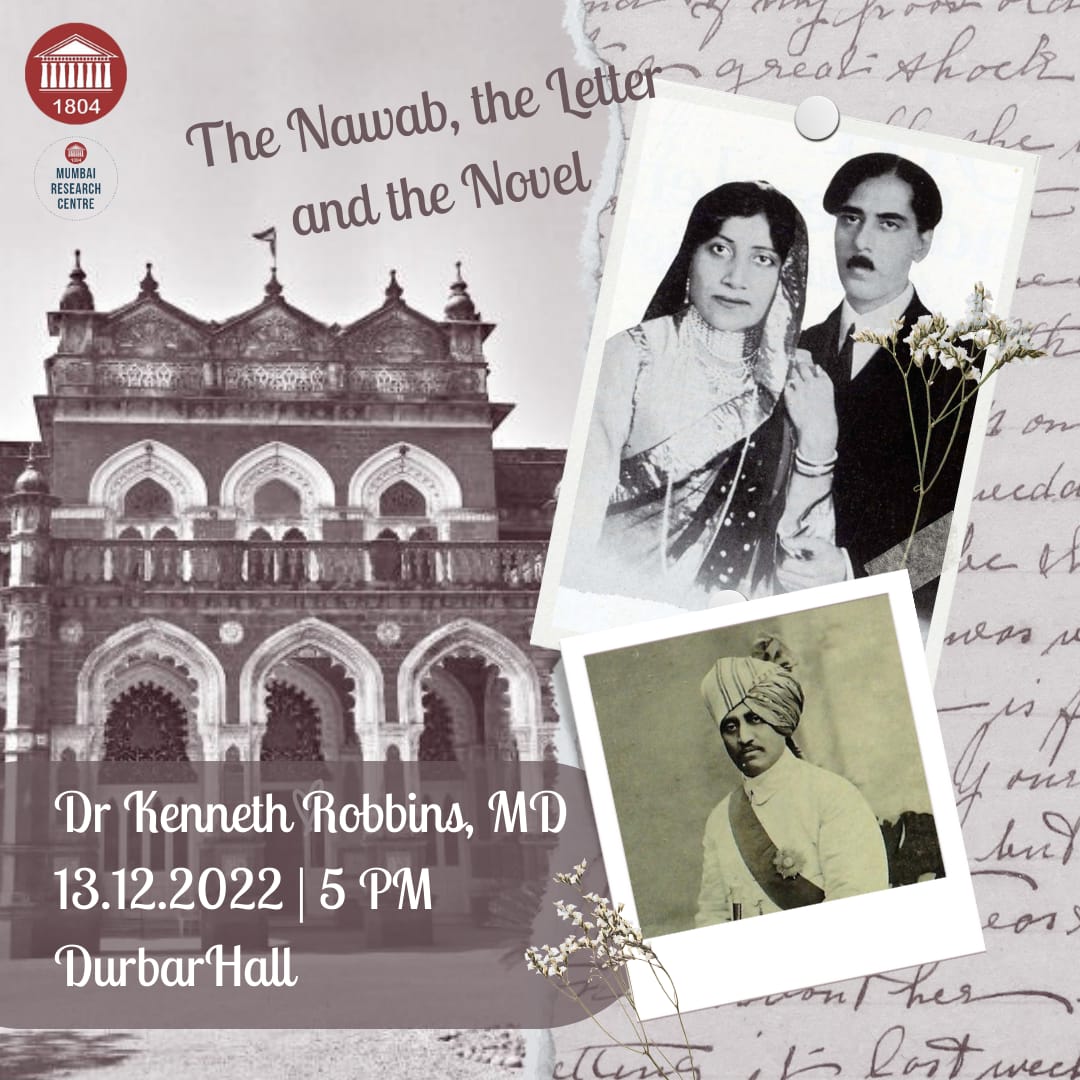
The Nawab, the Letter and the Novel Dr. Kenneth Robbins, MD
13th December 2022 at 5 p.m.
This is the story of two Muslim feminist sisters Nazli and Atiya Fyzee (of the Tyabji family) and their husbands, Nawab Sidi Ahmad Khan of Janjira and the painter-writer Fyzee Rahamin respectively. When the Nawab took a second wife to produce an heir, Nazli Begum left to live in Bombay with Atiya and Fyzee. After the Nawab’s death, the Begum contested Janjira state’s claim that she was divorced. She wrote a long diatribe to Queen Mary against her late husband, claiming the state's progress to her efforts. All of her charges were expanded in Fyzee Rahamin’s novel "Gilded India". Nazli’s letter and Fyzee’s novel are important early feminist documents extolling the benefit of rule by women over that by men.
Kenneth X. Robbins is an independent scholar on South Asia. His major areas of interest are the Maharajas and Nawabs, minority groups in India (such as African Muslim elites and Jews), and religious traditions (Sufis, the Bhakti movement, etc.). He has published about 120 articles and edited or authored many books. As an archivist-collector, Robbins has curated many exhibits and scholarly conferences dealing with Maharajas and Nawabs in Indian history, paintings, photographs, art, religion, medicine, numismatics, and philately as well as multiple exhibits on Jews in India.
- Dr. Shehernaz Nalwalla, Chairperson, Mumbai Research Centre
- Prof. Mangala Sirdeshpande, Hon. Secretary
 The Literary Club of the Asiatic Society of Mumbai is delighted to invite you to a presentation of the works of the French Nobel prize winning author Annie Ernaux on Monday 5th December 2022 at 5 pm.
 The Mumbai Research Centre of the Asiatic Society of Mumbai is pleased to present a nature walk with Mr Pracin Subramanian to know more about Mumbai's winged winter visitors. The Bhandup Pumping Station provides access to the Thane Creek Flamingo Sanctuary, and has long been a favorite for watching migratory birds. The creek and its adjacent wetland and mudflats lie close to the Central Asian Flyway, through which birds like pipits, godwits, eagles, ducks, plovers, ospreys, starlings, pochards, harriers, geese, shelducks, falcons, stonechats, buntings, shovelers and rosefinches migrate south from Siberia. Mumbai's warm climate and abundant biodiversity make it a suitable wintering area for these birds, along with subcontinental migrants like egrets, herons, ibises, spoonbills, storks and flamingos.
 The Asiatic Society of Mumbai
Mumbai Research Centre
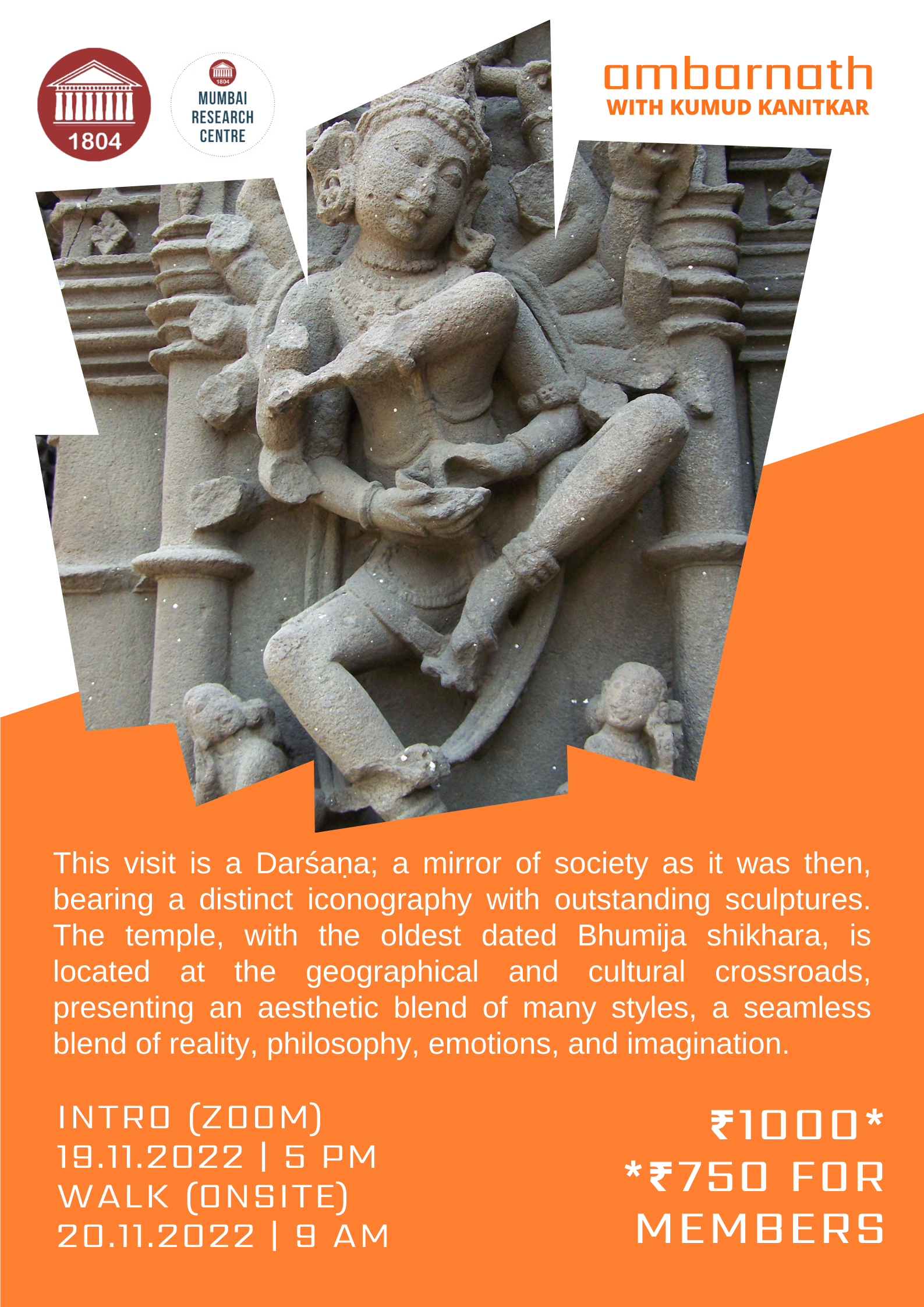
The Mumbai Research Centre of the Asiatic Society of Mumbai presents a specially curated visit to the Ambarnath Shivalaya with Dr. Kumud Kanitkar.
Built by three 11th century kings Chittaraja, Nagarjuna and Mummuni, the Ambarnath Shivalaya, on the bank of the Waldhuni, represents the zenith of Shilahara architecture, bearing a distinct iconography with outstanding sculptures. The oldest temple to be built in the Bhumija style, its garbhagriha is below ground, and open to the sky, and connected to the mandapa by a narrow antarala. It is richly decorated in sculptures, delivering a complete iconography of Shaiva and Vaishnava beliefs in stone.
This visit is a Darśaṇa; a mirror of society as it was then, located at the geographical and cultural crossroads, presenting an aesthetic blend of many styles, a seamless blend of reality, philosophy, emotions, and imagination.
The visit will be preceded by an orientation lecture (mandatory) by Dr. Kanitkar the previous evening (19th November). [Poster attached].
Date: 20th November 2022 (Sunday)
Time: 10.00 am to 2.00 pm
Venue: Ambarnath Shivalaya
(Participants to reach Ambarnath on their own)
Dr. Kumud Kanitkar is the author of the definitive monograph on the Ambarnath Shivalaya, and a renowned expert on Shaiva iconography. Her study has been followed by an equally masterly study of the Bhuleshwar Shivalaya of Pune.
Registration:
For members: ₹ Rs.750.00 | Payment Link: https://rzp.io/l/AmbMem
For the general public: ₹ Rs.1,000.00 | Payment Link: https://rzp.io/l/AmbGen
- Prof. Mangala Sirdeshpande , Hon. Secretary
- Dr. Shehernaz Nalwalla, Chairperson, MRC
- Dr. Madhu Kelkar, Convenor, MRC
 The Asiatic Society of Mumbai
Mumbai Research Centre
Curated walk through Fort, mapping the old fort, with Raamesh Gowri Raghavan.
Sunday 6th November 2022 from 4.30 to 6.30 p.m.
The Mumbai Research Centre of the Asiatic Society of Mumbai presents a specially curated walk through Fort, mapping the old fort, with Raamesh Gowri Raghavan.
The Fort precinct of Mumbai was once a real fort, bristling with bastions and cannons. This walk will map the old curtain walls and gates as they stood. The fort had rather humble beginnings in 1665, as defences around the old manor house of Garcia d'Orta. 20 guns secured the settlement from the Dutch and the Marathas. In 1715, after multiple struggles with the company bosses in London and Calcutta for permission to spend on further fortifications, governor Charles Boone was able to begin the construction of a larger curtain wall with twelve bastions and three gates - the Bazaar Gate, the Church gate and the Apollo gate (between St.Andrew’s Church and Rampart Row). It was finished in 1722, with further defences added in the next 30 years in fits and starts, including the infamous choleric ditch.
The fort oversaw a deforested Esplanade, which was often the site of camp accommodation during the oppressive summers (for the Europeans). In 1862, as the population (beset with overcrowding, fires and cholera) expanded, and the threats from the Dutch, Siddis and Marathas had faded away, there was clamour for removing the ramparts. The Governor Sir Bartle Frere oversaw the rampart removal, and the transformation of the space created into the new 'Frere Town'.
Date: Sunday, 6th November 2022
Time: 4.30 to 6.30 pm
Venue: Fort (CSMT to Gateway and back)
(Exact assembly spot will be communicated in the dedicated WhatsApp group.)
Raamesh Gowri Raghavan takes an interest in the ethnoarchaeology of the Bene Israel; ancient board games, the archaeology of ballistic weapons and fortifications, ancient Indian trade and Shaiva iconography. He has taught epigraphy, linguistics, archaeozoology, palaeobotany, evolutionary biology, Dravidian linguistics and haikai at University of Mumbai CEMS, Sathaye College, Wilson College, INSTUCEN Trust, Mumbai Research Centre of the Asiatic Society of Mumbai, and Speaking Archaeologically.
For members: https://rzp.io/l/ForMem
For others: https://rzp.io/l/ForGen
- Prof. Mangala Sirdeshpande , Hon. Secretary
- Dr. Shehernaz Nalwalla, Chairperson, Mumbai Research Centre